.svg)
CHIJ Katong Convent
Explore the history of CHIJ Katong Convent.
Image Gallery
School History
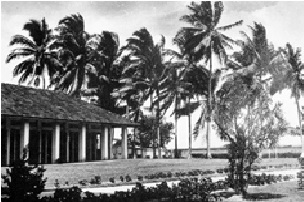
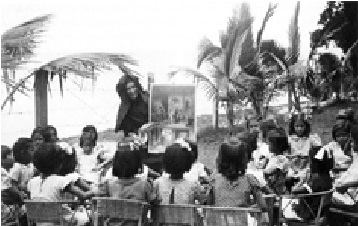
CHIJ Katong Convent was established as a private English primary school in 1930 under Sister St Theodora, the first principal. The first enrolment comprised 197 students, including 26 boys who were later transferred to St Patrick’s School in late 1932. In 1939, Sister St Vincent de Paul, who had succeeded Sister St Theodora in 1932, further expanded the school, and the enrolment grew to almost 400 students. Almost all the students lived very near the school, on East Coast Road or in estates near East Coast Road such as Joo Chiat and Frankel. At the outbreak of World War II in 1941, the school building on Martia Road was taken over by the British and became a military camp.
Despite the war and the challenges, Sister St Vincent de Paul was determined to continue her mission. Hence Katong Convent moved to Ceylon Road where it shared premises with St Hilda’s School. In line with the educational policies of the Japanese occupying forces, the school had to change its name to a secular one and became known as Ceylon Road Girls’ School. Many families stopped sending their daughters to school during this period and enrolment dropped to just over 100 students.
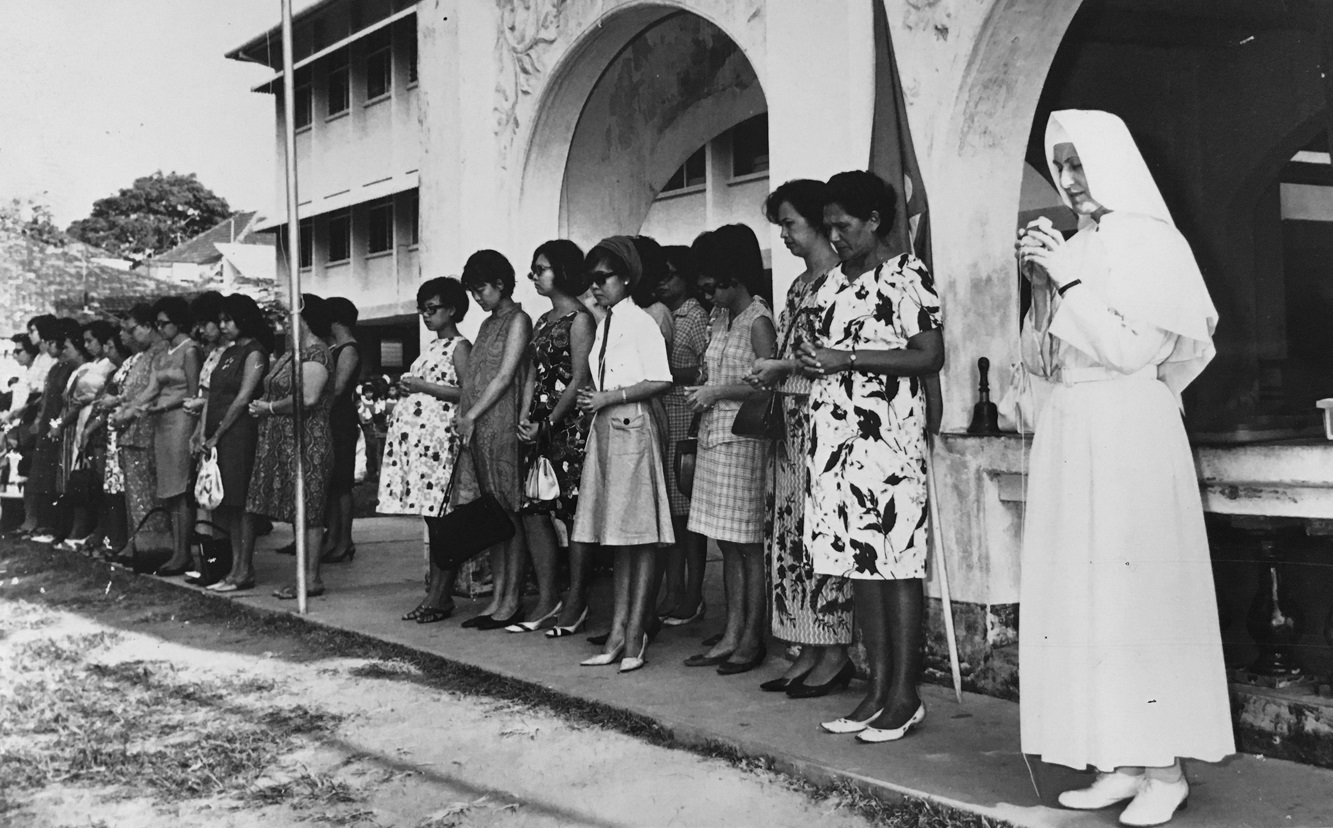
After the war, when the premises were returned in 1946, Sister Finbarr took over as the principal and, except for the period of 1954 to 1958, held office until 1971. During her term, the enrolment of Katong Convent grew significantly, and CHIJ Opera Estate Primary School was established in 1959 to accommodate the rising enrolment. The 1950s also saw the beginnings of English literature, plays, performances and singing taking root in the school curriculum, which were greatly promoted and encouraged by Sister Finbarr.
After Sister Finbarr’s retirement, Mrs Marie Bong, who had been a member of the teaching staff since 1951, became the first lay principal of Katong Convent in 1972. Under her guidance, the school became well known for choral speaking, creative writing and Shakespearean productions.
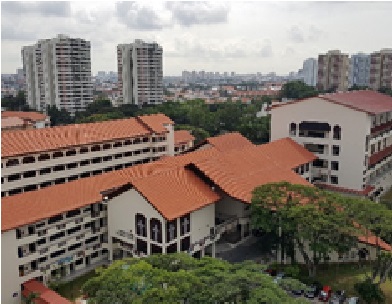
At the end of 1986, under the leadership of Mrs Karen Oei, the second lay principal, the school shifted premises from Martia Road to its current Marine Terrace site. In 1990, the primary section of the school merged with Opera Estate Convent to form CHIJ Katong Primary, and returned to its former site on Martia Road. From that year, CHIJ Katong Convent operated solely as a secondary school.
Principals:
- Sister St Theodora (1930–1932)
- Sister St Vincent de Paul (1932–1945)
- Sister Finbarr (1946–1954)
- Sister Veronica (1954–1958)
- Sister Finbarr (1959–1971)
- Mrs Marie Bong (1972–1985)
- Mrs Karen Oei (1986–1996)
- Mrs Lysia Kee (1997–2004)
- Ms Lam Ai-Leen (2005–2013)
- Ms Chan Gek San, Patricia (2014–2021)
- Mrs Hilda Thong (2022)
- Mrs Tan Mei Chuen (2023 - present)
Key Milestones
key milestones
1930 | Founding of Katong Convent on Martia Road in Katong. |
1980 | Formation and registration of Katong Convent School Alumnae Association. |
1987 | Relocation from Martia Road to current Marine Terrace site. |
1988 | Development of primary school at Martia Road. |
2003 | Gained autonomous status. |
2007 | Selected to offer O-Level Drama in recognition of the school’s niche in the performing arts. |
2010 | Attained School Distinction Award. |
2011 | Selected to offer Enhanced Art Programme in recognition of the school’s strength in the visual arts. |
2016 | Attained the School Distinction Award and Best Practice Awards under the Ministry of Education’s Revised Masterplan of Awards for Schools. |
2018 | Commemoration of return to Marine Terrace and completion of all five heritage alcoves. |
School Motto
Simple in Virtue, Steadfast in Duty
To be simple in virtue is to cultivate a personal honesty that helps one relate to others with respect, openness and sincerity. Virtue is nobleness of character nurtured by a genuine desire to live according to God’s will as revealed in the Gospel. To be steadfast in duty is to be faithful in fulfilling one’s obligations and having the capacity to rise above difficulties or obstacles to execute and complete a task in the service of others.
School Crest
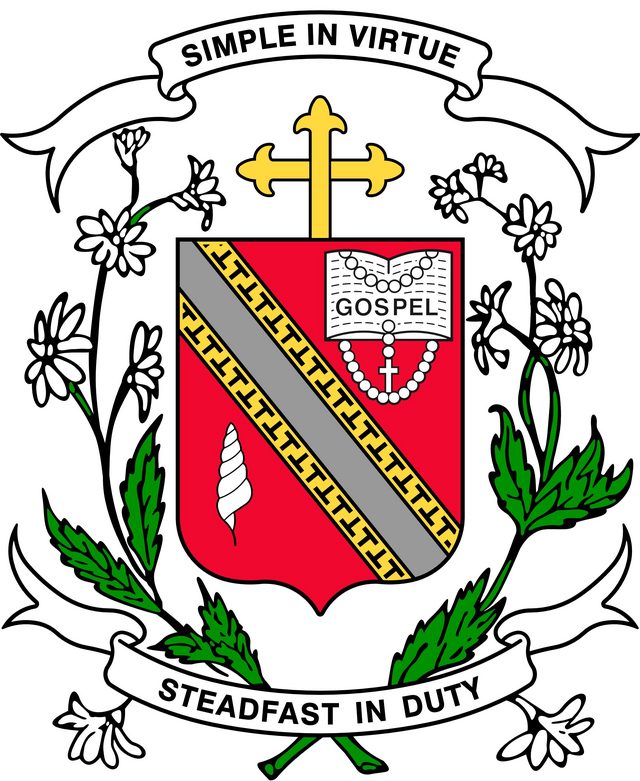
The red shield symbolises God’s all-embracing message of love. The open Gospel represents the teachings of Christ and is a source of inspiration that guides the school community. The silver rosary symbolises prayer and is the story of the Gospel as seen through the eyes of Mary, the Mother of Jesus. The golden distaff and spindle are symbols of womanly labour and are reminders of the dignity of work and the satisfaction and fulfilment to be found in a task well accomplished. The cross is the symbol of salvation as well as the suffering and death of the Lord Jesus Christ. The garland of marguerites is symbolic of purity and simplicity – charming traits of girlhood. Emblazoned on the crest is the motto of all CHIJ schools, ‘Simple in Virtue, Steadfast in Duty’.
The CHIJ crest was designed by Mere Saint Aloysia, Superior General (1877–1901) and her senior students in 1894. The CHIJ school crest is an international badge worn by students of the Infant Jesus schools in South America, the United Kingdom, Europe, Africa, Japan and Southeast Asia.
School Song
Forward Katong Convent
Make our future bright
To achieve our aims
Bravely we will fight
Guide us in our labours
To the Lord we pray
In wisdom, strength and courage
Growing day by day
Solidly united
By our motto sound
Simple in virtue
Strong in duty bound
In duty to our country
Let us steadfast be
Serving it with cheerfulness
And with loyalty
Let us ever noble be
In thought and word and deed
Striving to our utmost
Always to succeed