.svg)
Dunman High School
Explore the history of Dunman High School.
Image Gallery
School History
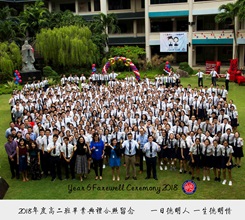
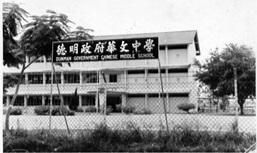
Dunman High School was established on 14 October 1956, amidst a period of political unrest. Originally known as Kallang West Government Chinese Middle School, the school was renamed Dunman Government Chinese Middle School when it moved to Dunman Road the following year.
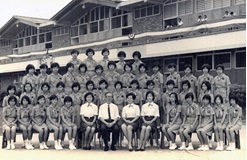
With an initial enrolment of 111 boys in 1957, the school population grew rapidly to about 2,000 in the 1960s. Its students performed well and achieved the best O-Level examination results among Chinese-medium secondary schools nationwide every year from 1969 to 1978. This excellent academic performance was recognised when, in 1979, the school was selected as one of the nine Special Assistance Plan secondary schools. It was then also renamed Dunman High School.
Dunman High was selected by the Ministry of Education in 1982 to offer the Music Elective Programme for musically talented students. In 1994, Dunman High was also one of the first six schools to be accorded autonomous status. With a proven track record, the school was chosen to host the Gifted Education Programme in 1996. In 2005, Dunman High launched the six-year Integrated Programme that leads directly to the A-Level certification. It was the first government secondary school to offer the Integrated Programme. In the same year, Dunman High embarked on the Bicultural Studies Programme to nurture students who can traverse comfortably between Chinese and Western cultures. These attest to the strong confidence that the Ministry of Education and the community have in the school.
The school underwent a physical expansion in 2007. In 2009, Dunmanians returned to the upgraded premises with state-of-the-art facilities including a performing arts centre and a life sciences laboratory. In 2011, Dunman High was recognised as the East Zone Centre of Excellence for Teaching and Learning. The school sought to promote and raise the standard of professional practices in curriculum design, pedagogy and assessment for educators in East Zone schools. In 2019, Dunman High participated in the Joint Admission Exercise to create greater diversity in its learning environment and further enrich the learning experience for its students.
Today, Dunman High offers a comprehensive range of programmes that reflects its continuous commitment to provide a high-quality, holistic education for all its students. Notable programmes include the Knowledge Skills Programme, Talent Development Programme and Bicultural Studies Programme.
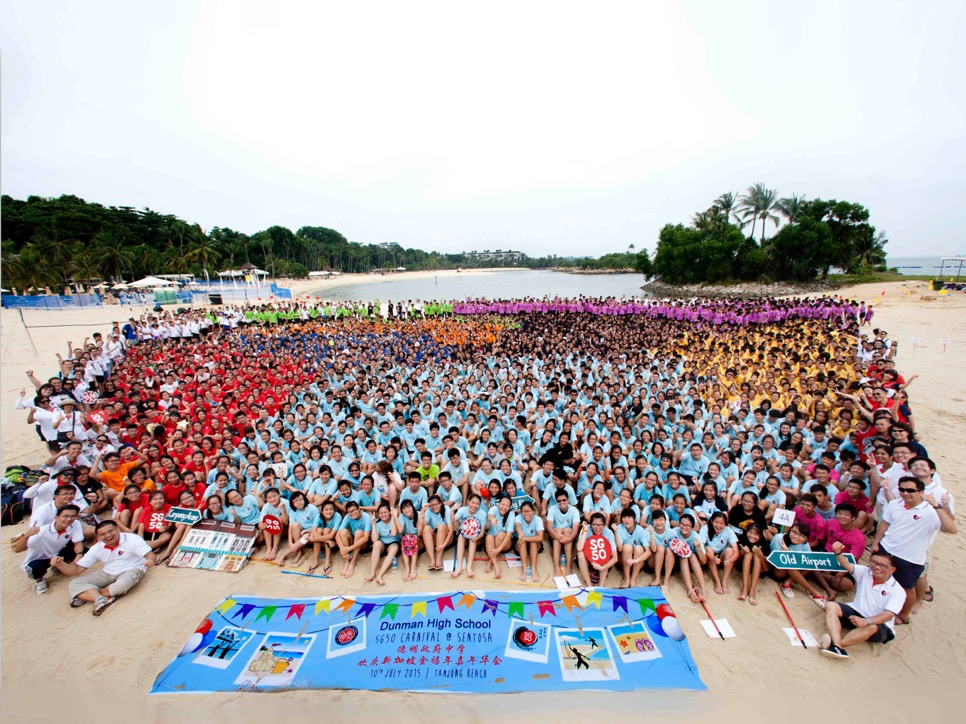
In 2016, the school celebrated its 60th anniversary.
Principals:
- Mr Sun Hwan Sin (1956–1959)
- Mr Chen Jen Hao (1959–1969)
- Mdm Shu June Mai (1969–1978)
- Mr Lim Nai Yan (1978–1993)
- Mr Cheah Chak Mun (1994–1998)
- Mr Tan Thiam Hock (1998–2004)
- Mr Sng Chern Wei (2004–2009)
- Dr Foo Suan Fong (2010–2016)
- Mr Low Teck Eng Tony (2016–2021)
- Mr Chan Ying Yin (2022 - present)
Key Milestones
key milestones
1956 | Founding of Dunman Government Chinese Middle School. |
1979 | Became a Special Assistance Plan school and renamed as Dunman High School. |
1994 | Gained autonomous status. |
1995 | Relocation to present premises at Tanjong Rhu Road. |
1996 | Start of Gifted Education Programme. |
2002 | Official opening of first government student hostel. |
2005 | Start of Integrated Programme. |
2011 | Official opening of new campus at 10 Tanjong Rhu Road after PRIME upgrading. |
2016 | Celebration of 60th anniversary. |
2019 | Participation in the Joint Admission Exercise for the first time. |
School Motto
Honesty, Trustworthiness, Moral Courage and Loyalty
诚,信,勇,忠
School Crest
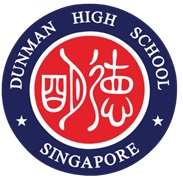
The school crest was designed by the late Mr Chen Jen Hao, the second principal of the school (1959–69), and the late Mr Liu Kang, a well-known pioneer in the local art scene, who was an art teacher in the school during the 1960s.
The name De Ming (‘德明’) in Chinese is not merely a transliteration of ‘Dunman’. It also draws meaning from the first line of a Confucian classic, Da Xue (《大学》 ), which states that the main objective of education is to help people manifest the virtues and morals that are already inherent in them (‘大学之道在明明德’). The two Chinese characters in the crest written in Zhuan (篆) calligraphy style is the work of Mr Chen. With a history spanning over 2,000 years, Zhuan calligraphy is ornamental in character and embodies the idea of preserving a tradition. This symbolises the school ethos, which is to build on and foster traditional values.
The use of the red background symbolises passion and the strive for success, while the blue background signifies peace and dignity. The circular border represents wholeness and unity, and symbolises the pursuit of universality, derived from the classic Liji Daxue (《礼记大学》).
School Song
德明中学 矗立加东
亭亭松影 习习海风
集我英才 汇于一家
文艺科学 同冶同攻
树模楷 教诚信
立风范 诲勇忠
吾学兮博通吾德兮高崇
师生共陶镕浩气干长空
爱护我德明永志乎五中
光大我德明永志乎五中