.svg)
Montfort Junior School
Explore the history of Montfort Junior School.
Image Gallery
School History
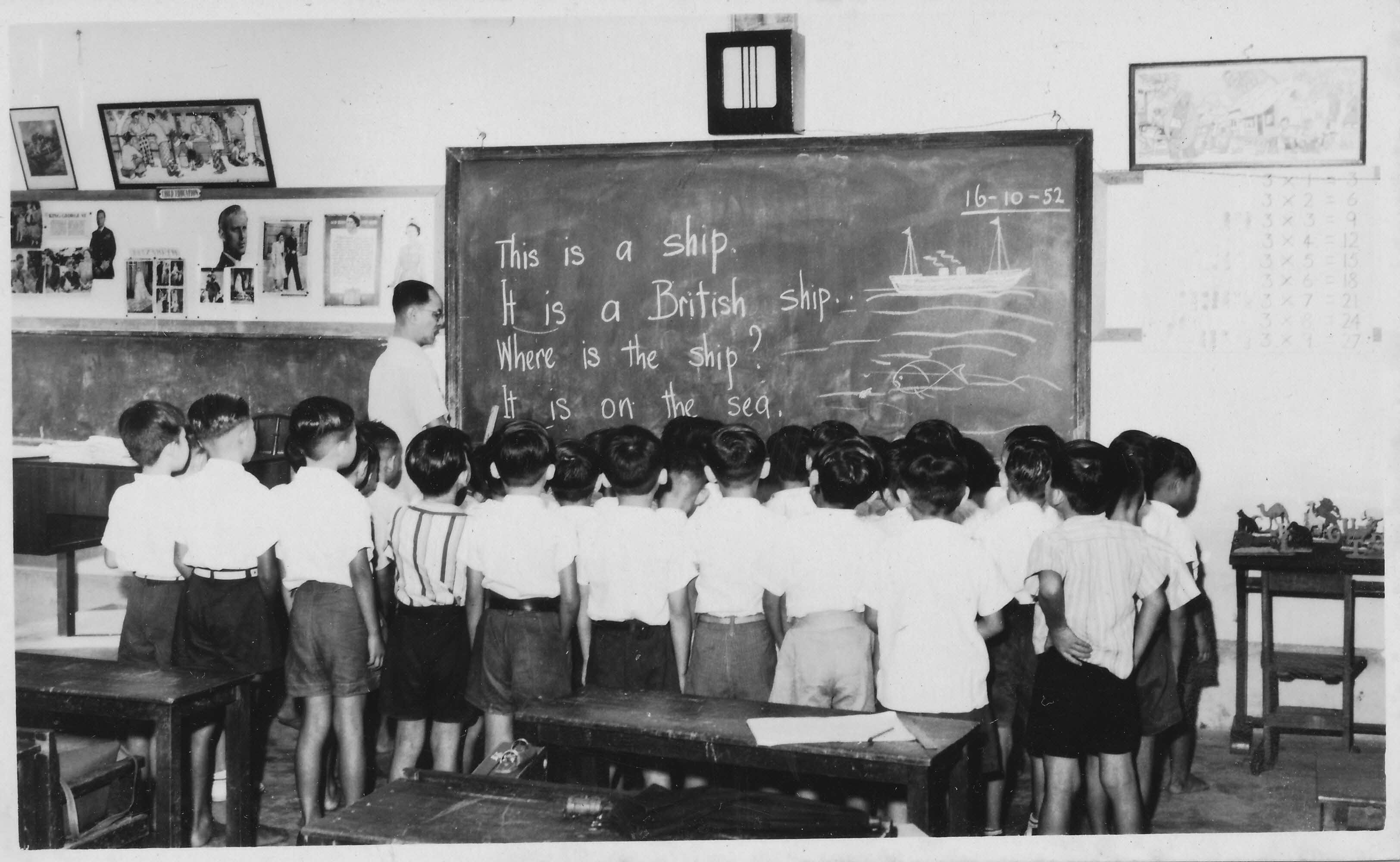
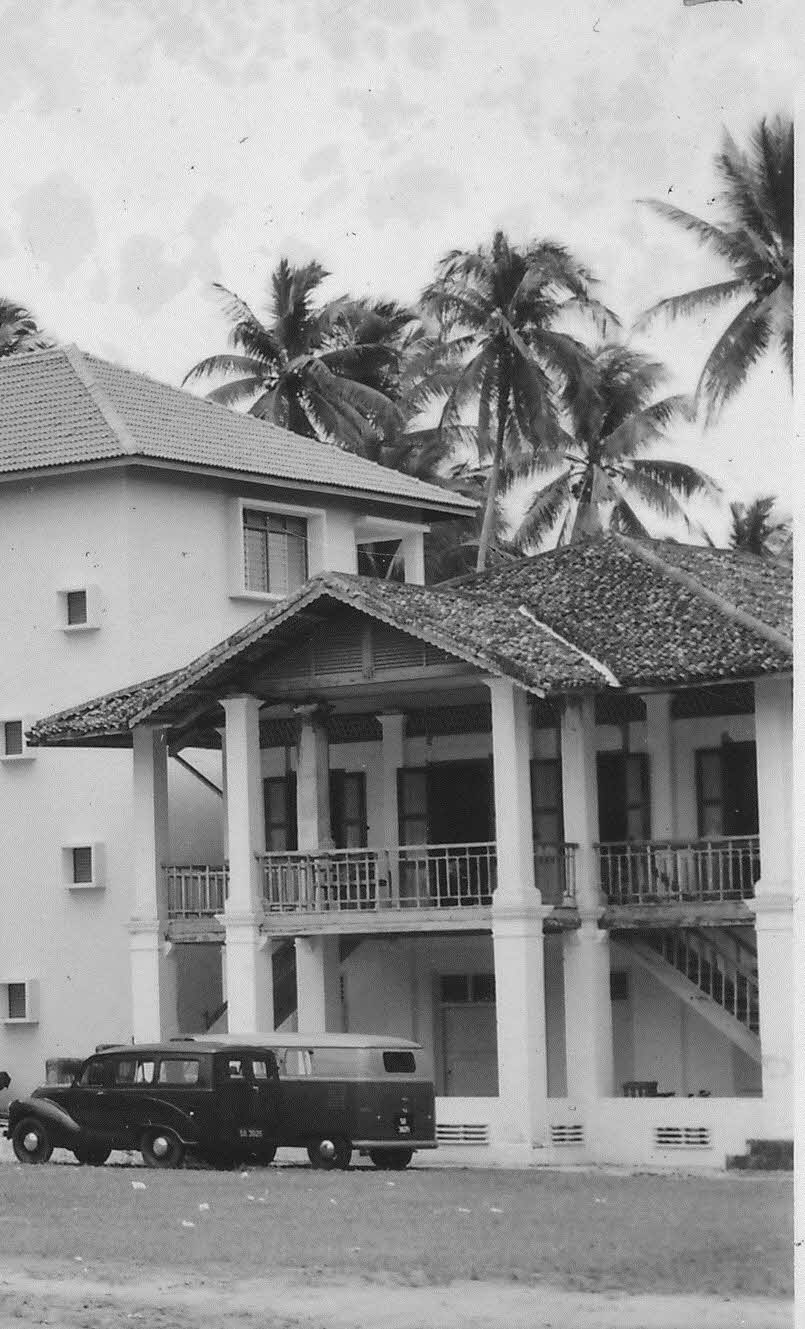
Montfort started as a single class of students in rural Serangoon in 1916. The class, which was taught in English, operated on the upper floor of a two-storey building next to a church in Upper Serangoon. It became Holy Innocents’ English School, Montfort School’s predecessor. The school building had been the brainchild of Father Laurent, the parish priest of the Church of the Nativity of the Blessed Virgin Mary. His successor, Father Henry Duvelle, finished building the school and started the first English class.
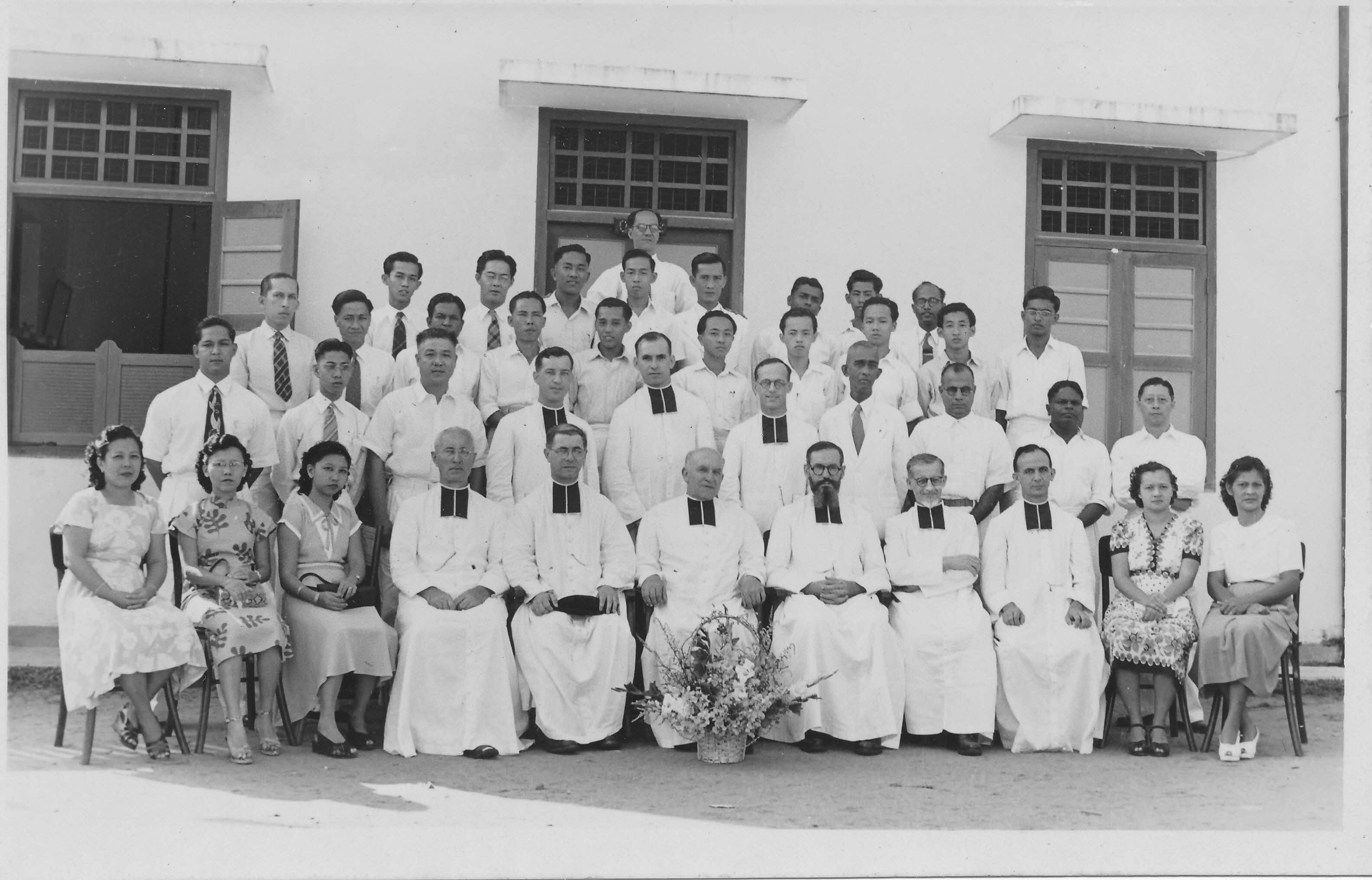
The school expanded steadily and had nine classrooms by 1922. In 1936, the school was placed under the management of the Brothers of St Gabriel and it continued to grow rapidly. At the end of 1941, the school held its Senior Cambridge Examination, just before the Singapore fell to the Japanese during the Second World War. All the candidates passed, though they had to wait until 1946 – after the Japanese Occupation – to find out.
The postwar years were a period of tremendous growth for the school. In 1948, more Brothers arrived, and that year also saw the addition of a second floor to the five-classroom block along Upper Serangoon Road. The extension was opened by Sultan Ibrahim of Johor, great-grandfather of the present sultan, who had donated generously to the school-building fund.
In 1951, the school published its first school annual, which archived the history of the school. In 1959, Holy Innocents’ English School was renamed Montfort School in honour of its founder, St Louis Marie De Montfort, whose efforts to educate the young, were carried on by the Brothers of St Gabriel.
The school opened its doors to female students in 1961. The girls were admitted to the pre-university classes, which catered to both science and arts students. The last batch of pre-university students graduated from the school in 1975, when junior colleges were set up in Singapore.
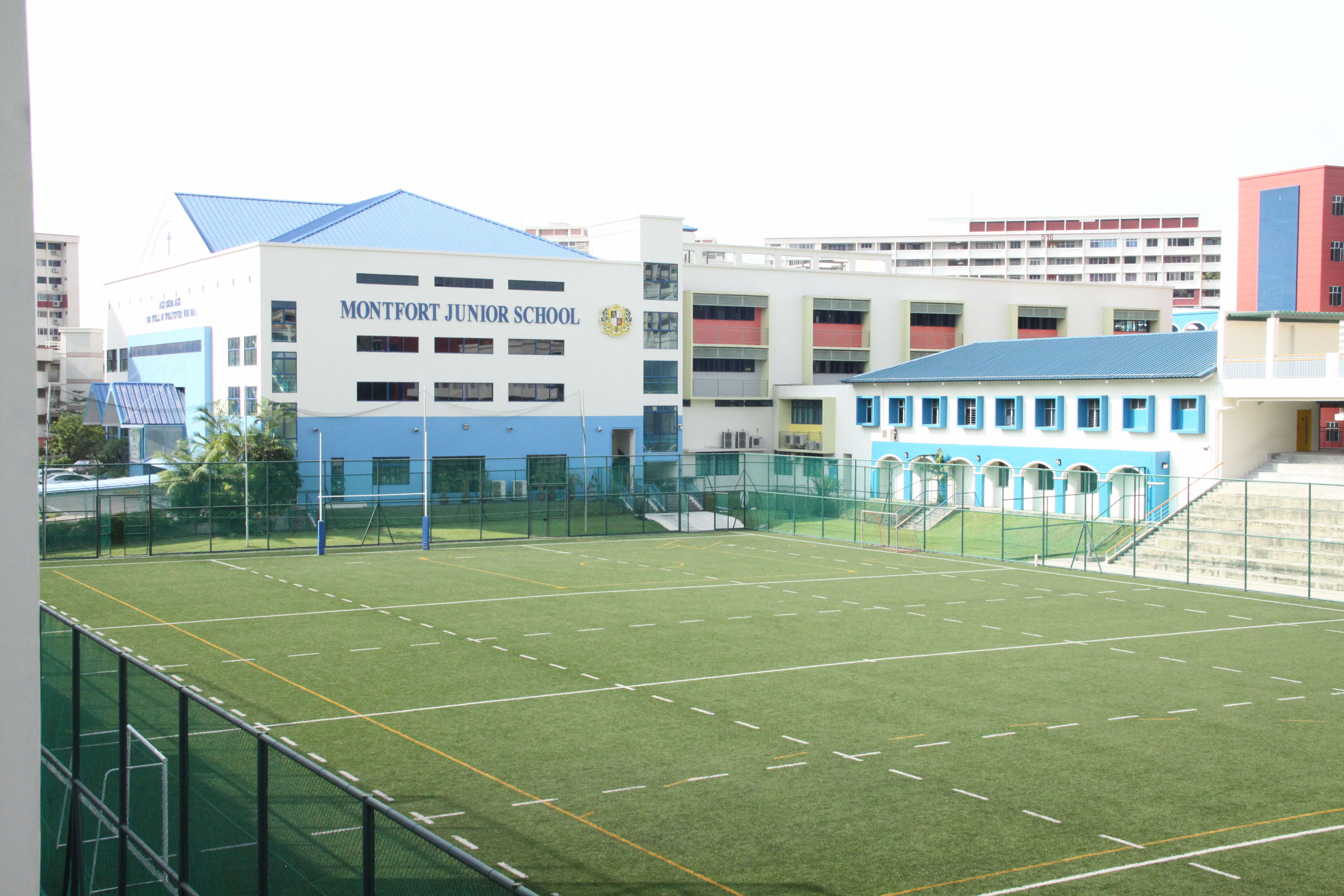
Montfort School split into Montfort Junior School and Montfort Secondary School in 1974. In 1987, the school was given a new site at Hougang Avenue 8, and the building was completed in 1991. The following year, the school moved to new premises and it was officially declared open on 24 July 1993.
The school was rebuilt under PRIME upgrading in 2003, and an indoor hall was added in 2008. In 2016, Montfort celebrated its 100th Founder’s Day with activities throughout the year. The school underwent PERI upgrading, which was completed in 2018.
Principals:
Father Henry Duvelle(1916–1919)
Father E. Becheras (1920–1933)
Father Moses Koh (1934–1936)
Brother Gerard Majella (1936–1937)
Brother Louis Gonzaga (1938–1955)
Brother Noel Berthomieu (1955–1957)
Brother Louis Gonzaga (1958–1962)
Brother Thomas de Aquinas (1962–1964)
Brother Albert Proulx(1964–1974)
Mr John Wee (1974–1989)
Mr Tng Teng Chua (1990–1996)
Mr Peter Foo (acting)(1996–1997)
Ms Cecilia Ng (1997–2003)
Mrs Judina Cheong (2003–2009)
Ms Genevieve Chye (2009–2014)
Mr Wilbur Wong (2014–2022)
Mr Victor Tan (2023 - present)
Key Milestones
Key milestones
1916 | Montfort School began as a single class in a parish school called Holy Innocents’ English School. |
1936 | The Brothers of St Gabriel took over the running of Holy Innocents’ English School. |
1959 | Another extension was completed. Holy Innocents’ English School was renamed Montfort School. |
1961 | The school opened its doors to female students in the pre-university classes. |
1974 | From being a full school, the school split into two schools to become Montfort Junior School and Montfort Secondary School. |
1992 | Montfort Junior School moved to new premises at Hougang Avenue 8. |
1993 | Official opening of Montfort Junior School on 24 July 1993. |
2003 | The school was rebuilt under the PRIME programme. |
2016 | Celebrated its 100th Founder’s Day. |
2018 | The school completed PERI upgrading. |
School Motto
AGE QUOD AGIS
Do well in whatever you do
School Crest
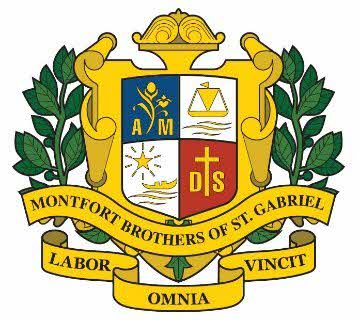
The school crest was created when the Brothers of St Gabriel took over the management of the school in 1936. In 2014, the current crest was adopted, in line with the rest of the schools around the world which are under the Brothers.
The coat of arms has the letters ‘AM’ in the top-left quadrant, which stand for ‘Ave Maria’ (Latin for ‘Hail Mary’), and a lily, which symbolises the purity of the Blessed Virgin Mary, to whom the founder of the Order of St Gabriel, St Louis Marie de Montfort, was devoted.
God was the sole motivating force in the life of St Louis Marie de Montfort. This is symbolised by the cross with the letters ‘DS’ in the bottom-right quadrant, which stand for ‘Dieu Seul’ (French for ‘God Alone’).
The image of a star in the bottom-left quadrant symbolises the guidance of the Blessed Virgin Mary on life’s journey. Perseverance in the face of the storms of life is symbolised by the image of a sailboat in the top-right quadrant. ‘Our Lady, Star of the Sea’ is another title given to the Blessed Virgin Mary, who is the guiding star.
The crest also has the words ‘Montfort Brothers of St Gabriel’ and ‘Labor Omnia Vincit’ (Latin for ‘Labour conquers all things’) on it.
School Song
All ye sons of Montfort School, Ever grateful be and true
To your Alma Mater dear, For her loving care of you.
Keep your filial piety, Burning bright your whole life through,
Ever jealous of her name, Ever mindful of her claim.
Chorus:
Hark! Her bugle sounds aloud, Rise her sons, and play your part,
With a song upon your lips and a courage in your heart.
See! Her banner in the breeze, freely flutters high and smart!
Feel in you a surging pride, when your Mater’s colours ride.
All ye sons of Montfort School, Onward, steadfastly advance,
Higher, nearer to your star, Never casting back a glance;
Forge ahead, relentlessly, Trusting naught to happy chance,
Onward, onward valiantly, Onward press with destiny.
All ye sons of Montfort School, Take whatever comes your way,
Every blessing with a smile, Every woe without dismay;
All undaunted by the odds, You may counter in life’s fray,
Boldly march in spirit high, Nobly live, and nobly die