.svg)
Singapore Chinese Girls' School
Explore the rich history of Singapore Chinese Girls' School.
Image Gallery
School History
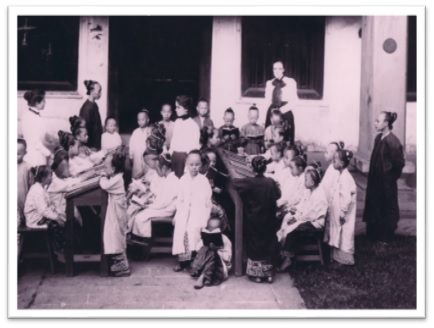
Singapore Chinese Girls’ School (SCGS) was established on 1 July 1899, with an English lady teaching seven Peranakan girls in a cramped Hill Street house with a leaky roof. Thus began the first girls’ school in Singapore opened by the local community. This was thanks to founders Sir Song Ong Siang and Dr Lim Boon Keng’s strong convictions that girls must be empowered with an all-rounded education, opposing the traditional thinking of the times.
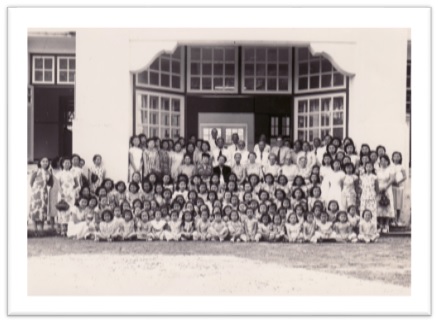
Despite an uncertain start, enrolment grew. By 1918, enrolment had reached 215. In 1924, the school moved to 37 Emerald Hill, which would become an integral part of its identity for the next 70 years. Meanwhile, the creation of its iconic school crest and a locally inspired uniform, comprising a white samfoo top and blue trousers, contributed to the blossoming SCGS identity. By 1936, SCGS had developed its house system, cookery and swimming classes, and a Girl Guides Company that received postcards from Britain’s Queen Mary.
After World War II, SCGS opened to all races, and had enrolled 700 girls by 1950. The school had its first Asian principal in 1951. In 1971, SCGS prepared its graduating girls for the first Singapore-Cambridge General Certificate of Education examinations and attained 100% passes. SCGS girls also achieved sporting glory, especially in swimming and athletics. Dance then came to the fore, and later became a well-known SCGS institution. In 1989, SCGS achieved independent status.
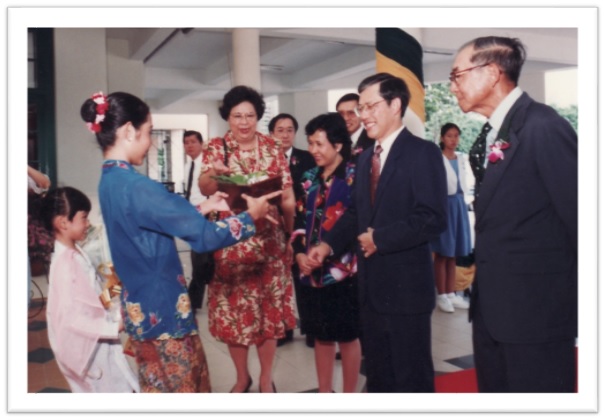
On 4 July 1994, SCGS bade farewell to its Emerald Hill premises, which had been declared a significant historical site by the National Heritage Board, and moved to 190 Dunearn Road. A time capsule installed in the lobby in 1999 marked a century of illustrious school history. The school’s culture of excellence continued to be upheld.
In 2013, SCGS was the first school to be designated as a Centre of Excellence for Humanities. SCGS also offered an additional six-year Integrated Programme leading to the GCE A-Level at Eunoia Junior College.
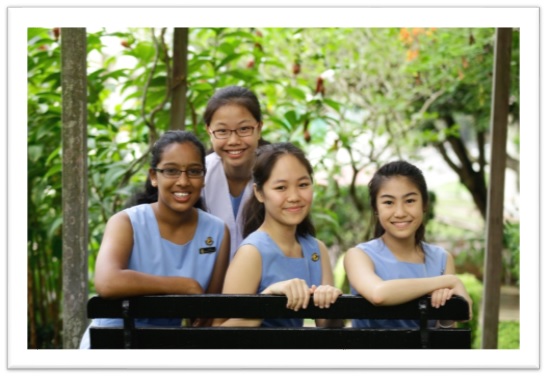
Today, SCGS continues to equip girls with the knowledge, skills and dispositions to be world-ready leaders. Its three pillars – the Talent, Character and Leadership, and Living and Life Skills Programmes – form a holistic experience to develop women who will stand out and lead their generation with confidence, purpose, principle and poise.
Principals:
- Ms Mary Geary (1899–1902)
- Ms Mary Lemon (1902–11)
- Ms L. Cook (1911–26)
- Ms J.E. Nesbitt (Mrs Jessie Geake) (1927–51)
- Mrs Tan Swee Khin (1951–56)
- Ms Tan Sock Kern (1956–78)
- Ms Rosalind Heng (1978–2006)
- Mrs Low Ay Nar (2007–16)
- Mrs Eugenia Lim (2016–2021)
- Mdm Linda Chua Mui Mui (2022-present)
Key Milestones
key milestones
1899 | Establishment of Singapore Chinese Girls’ School on Hill Street. |
1924 | Relocation to 37 Emerald Hill. |
1936 | Start of Junior and Senior Cambridge classes. |
1951 | Appointment of a non-European Headmistress. |
1971 | Students sat for the first Singapore-Cambridge General Certificate of Education (or GCE O-Level Examination). |
1989 | Attained independent status. |
1994 | Relocation to 190 Dunearn Road. |
2011 | Accorded School Excellence Award. |
2013 | Launch of Integrated Programme and became a dual-track school; Designated as a Centre of Excellence for Humanities. |
School Motto
Sincerity, Courage, Generosity, Service
School Crest
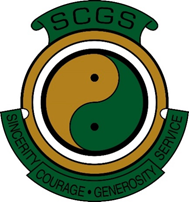
The colours of the school crest are jade and gold. These colours reflect the desire for every student to develop the qualities of a kim gek (‘gold’ and ‘jade’ in Hokkien) – a young lady who is the pride of her family because of the virtues she embodies. One observes the relevance of this connotation in the context of our current educational system, where the imparting of cultural values is stressed.
The yin-yang symbol on the crest is the traditional Chinese symbol for balance, representing how seemingly opposing elements can complement each other. Taken together, the school crest symbolises the balanced, holistic education that the school provides to groom kim geks who exemplify the values of sincerity, courage, generosity and service.
School Song
Glad that I live am I That the sky is blue
Glad for the country lanes and the fall of dew
After the sun the rain after the rain the sun
This is the way of life till the work be done
All that we need to do be we low or high is to see that we grow nearer the sky